
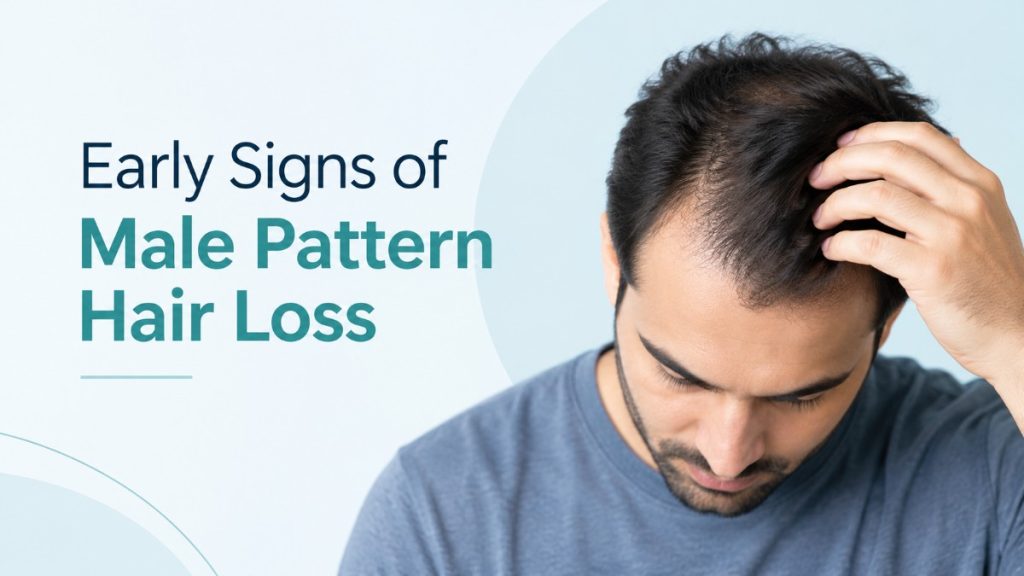
Early Signs of Male Pattern Hair Loss
Early Signs of Male Pattern Hair Loss can sometimes be subtle and easy to overlook. A few extra hairs on your pillow or in the shower may not immediately seem concerning, but gradual changes in the hairline, temples, or crown can be early indicators of a progressive pattern of hair loss.
Male pattern hair loss, also known as androgenetic alopecia, is one of the most common causes of hair thinning in men. It can develop gradually over several years, making the early changes difficult to recognize. Identifying the Early Signs of Male Pattern Hair Loss can help men understand what is happening to their hair and seek appropriate professional evaluation when needed.
What Is Male Pattern Hair Loss?
Male pattern hair loss is a common form of progressive hair thinning associated with genetic and hormonal factors. It occurs when hair follicles become increasingly sensitive to dihydrotestosterone (DHT), a hormone derived from testosterone.
Over time, susceptible follicles may become smaller. The hairs produced by these follicles can become finer, shorter, and less visible. This process is known as follicular miniaturization.
Male pattern hair loss does not necessarily begin with sudden or dramatic hair shedding. In many men, the first changes are gradual alterations in hair density or the shape of the hairline.
Understanding the Early Signs of Male Pattern Hair Loss is therefore important because noticeable baldness may occur only after the condition has progressed for some time.
7 Early Signs of Male Pattern Hair Loss
Recognizing changes early can help you monitor your hair more carefully. Some of the most common signs include:
1. Receding Hairline
A gradually receding hairline is one of the most recognizable Early Signs of Male Pattern Hair Loss.
The hairline may begin to move backward around the temples. Some men initially notice that the front corners of the hairline appear thinner or more open than before.
A mature hairline can also naturally develop with age, so a changing hairline does not automatically mean that a person has male pattern hair loss. The pattern, progression, family history, and examination of the scalp are important when assessing the change.
2. Thinning Around the Temples
Hair around the temples can become thinner before significant hair loss becomes visible elsewhere.
You may notice that the skin around the temples is more visible when your hair is wet or styled backward. The individual hairs in this region may also appear finer compared with the hair at the back or sides of the scalp.
Temple thinning can gradually contribute to the characteristic M-shaped hairline associated with male pattern hair loss.
3. Thinning at the Crown
Another important sign is reduced hair density around the crown, or the top-back portion of the scalp.
Crown thinning can initially be difficult to notice because it is not always visible when looking directly into a mirror. Some men discover it when they see photographs taken from above or notice increased scalp visibility under bright lighting.
Gradual crown thinning can become more noticeable as the hair follicles in the affected area produce progressively finer hairs.
4. Hair Becoming Finer Than Before
Not all hair loss begins with obvious bald patches.
One of the Early Signs of Male Pattern Hair Loss is a change in hair texture and thickness. Individual strands may become thinner, shorter, and less pigmented over time.
This happens because susceptible follicles can undergo miniaturization. Instead of producing a thick terminal hair, the follicle may eventually produce a much finer hair.
You may notice that your hair feels less dense even though you are still growing hair in the same areas.
5. Increased Visibility of the Scalp
As hair density decreases, more of the scalp may become visible.
This can be especially noticeable:
- Under bright overhead lighting
- When the hair is wet
- After showering
- When the hair is parted
- Around the crown
- Around the temples
Increased scalp visibility does not always mean male pattern hair loss. Hair texture, hairstyle, scalp conditions, and temporary shedding can also affect how much scalp is visible.
However, progressive scalp visibility deserves attention, particularly when it occurs together with changes in the hairline or crown.
6. Hair Takes Longer to Look Full
Another subtle sign is that your hair may no longer achieve the same volume it once did.
You may find yourself using more styling products, changing your hairstyle, or adjusting how you part your hair to make it appear fuller.
This can happen when individual hairs become progressively finer. Even if the number of visible hairs does not seem dramatically reduced, decreased hair shaft thickness can make the overall hair appear less dense.
7. Gradual Progression Over Time
The gradual nature of male pattern hair loss is itself an important clue.
You may not notice a major difference from one week to the next. However, photographs taken several months or years apart may reveal changes in:
- Hairline position
- Temple density
- Crown coverage
- Overall hair thickness
- Scalp visibility
Comparing photographs taken under similar lighting and from similar angles can sometimes make gradual changes easier to identify.
Is Hair Shedding Always a Sign of Male Pattern Hair Loss?
No. Some degree of daily hair shedding is normal because hair naturally moves through different stages of its growth cycle.
Hair goes through phases including:
- Anagen: active growth phase
- Catagen: transitional phase
- Telogen: resting phase
- Exogen: shedding phase
Temporary increases in shedding can occur because of stress, illness, nutritional problems, hormonal changes, medications, or other factors.
Male pattern hair loss, on the other hand, is primarily characterized by progressive miniaturization of susceptible follicles and a characteristic distribution of thinning.
This is why looking only at the number of hairs lost each day may not provide a complete picture.
How Is Male Pattern Hair Loss Different From Temporary Hair Shedding?
Understanding the difference between progressive pattern hair loss and temporary shedding can be helpful.
| Feature | Male Pattern Hair Loss | Temporary Hair Shedding |
|---|---|---|
| Typical pattern | Hairline, temples, crown | Often more diffuse |
| Progression | Usually gradual | May improve over time |
| Hair thickness | Can progressively become finer | Hair may retain normal thickness |
| Scalp visibility | May gradually increase | Can increase temporarily |
| Cause | Genetic and hormonal factors | Multiple possible triggers |
| Follicle miniaturization | Characteristic feature | Not typically the main process |
These patterns can sometimes overlap, so professional assessment may be necessary when hair loss continues or changes significantly.
What Causes Male Pattern Hair Loss?
Genetics plays a major role in male pattern hair loss. The condition can run in families, although inheritance is complex and does not depend on only one gene or one side of the family. Androgen sensitivity is another important factor. DHT can affect susceptible hair follicles, particularly in areas such as the temples, frontal scalp, and crown.
Over time, repeated exposure in genetically susceptible follicles can contribute to miniaturization. Other forms of hair loss can occur at the same time, so a dermatologist may consider additional causes when the pattern does not fit typical androgenetic alopecia.
When Should You See a Dermatologist?
It may be useful to seek professional evaluation if you notice:
- A progressively receding hairline
- Increasing temple thinning
- Noticeable crown thinning
- Persistent or increasing hair shedding
- Significant changes in hair density
- Sudden or unexplained hair loss
- Patchy areas of hair loss
- Scalp itching, scaling, redness, or pain
- Hair loss occurring along with other unexplained symptoms
Early assessment can help distinguish male pattern hair loss from other causes of hair thinning.
A dermatologist can examine the scalp, assess the distribution of hair loss, and determine whether additional evaluation is appropriate.
How Is Male Pattern Hair Loss Diagnosed?
Diagnosis generally begins with a detailed medical and hair-loss history.
A dermatologist may ask about:
- When the hair loss began
- How quickly it has progressed
- Family history of hair loss
- Recent illness or stress
- Medications and supplements
- Diet and nutritional factors
- Scalp symptoms
- Previous hair-loss treatments
The scalp and hair may then be examined closely. In some cases, dermoscopy or other investigations may help evaluate the hair follicles and identify the pattern of hair loss.
Blood tests are not automatically required for every person with male pattern hair loss. They may be considered when the history or examination suggests another possible cause.
Why Early Evaluation Matters
One reason to pay attention to the Early Signs of Male Pattern Hair Loss is that progressive follicular miniaturization can occur gradually. When hair thinning is identified early, a dermatologist can determine whether the pattern is consistent with androgenetic alopecia or another condition.
Early evaluation also gives you an opportunity to understand the expected progression, discuss suitable management options, and avoid treatments that may not be appropriate for the actual cause of hair loss.
Can Male Pattern Hair Loss Be Prevented?
There is no guaranteed way to prevent genetically influenced male pattern hair loss. However, recognizing changes early and maintaining good overall scalp and hair care can be useful. Avoiding unnecessary chemical or mechanical damage, maintaining a balanced diet, managing excessive stress where possible, and treating scalp conditions appropriately can support general hair health.
It is also important to avoid assuming that every hair-loss product or supplement is suitable for everyone. The underlying cause should be considered before starting treatment.
What Treatments Are Available?
Treatment depends on the cause, extent, progression, and individual circumstances. For confirmed male pattern hair loss, a dermatologist may discuss evidence-based options such as topical or oral medications, depending on the person’s suitability and medical history.
Some people may also consider procedures or hair restoration approaches when appropriate. Treatment decisions should be individualized because medications can have contraindications and potential side effects. A dermatologist can explain the expected benefits, limitations, and risks before treatment begins.
Frequently Asked Questions
1. What are the earliest signs of male pattern hair loss?
Early signs may include a gradually receding hairline, temple thinning, reduced crown density, finer hair strands, and increasing scalp visibility.
2. Is a receding hairline always male pattern baldness?
No. Hairlines naturally change with age, and not every receding hairline represents progressive male pattern hair loss. A dermatologist can assess whether the pattern is consistent with androgenetic alopecia.
3. Can male pattern hair loss start in the 20s?
Yes. Male pattern hair loss can begin in young adulthood, although the age at which it starts varies considerably between individuals.
4. Does losing hair during a shower mean I have male pattern hair loss?
Not necessarily. Some daily shedding is normal. The pattern of thinning, changes in hair thickness, and progression over time are more useful when evaluating male pattern hair loss.
5. Can male pattern hair loss affect the crown?
Yes. The crown is one of the common areas affected by male pattern hair loss. Thinning in this region may initially be subtle.
6. Why does my hair look thinner even though I still have hair?
Hair follicles affected by androgenetic alopecia can produce progressively finer hairs. This process can make the overall hair appear less dense even before obvious bald areas develop.
7. Is male pattern hair loss hereditary?
Genetics plays an important role. A family history of pattern hair loss can increase the likelihood, but inheritance is complex and does not follow a simple pattern.
8. Can stress cause male pattern hair loss?
Stress can contribute to increased hair shedding, but stress-related shedding and male pattern hair loss are different processes. Both can sometimes occur together.
9. When should I see a dermatologist for hair loss?
Consider professional evaluation if hair loss is persistent, progressive, sudden, patchy, or accompanied by scalp symptoms such as itching, redness, scaling, or pain.
10. Can early male pattern hair loss be treated?
Several treatment approaches may be available depending on the diagnosis and individual circumstances. Early evaluation allows a dermatologist to discuss appropriate options before deciding on treatment.