How Many Microneedling Sessions Are Needed for the Best Results?

If you’re considering microneedling to improve acne scars, fine lines, enlarged pores, or uneven skin texture, one of the first questions that naturally comes to mind is how many microneedling sessions are needed? The answer isn’t the same for everyone because every person’s skin condition, treatment goals, and healing response are different.
Understanding how many microneedling sessions are needed helps you set realistic expectations before beginning treatment. While some people notice visible improvements after the first appointment, others require multiple sessions to achieve gradual collagen remodeling and long-lasting skin rejuvenation. Since microneedling works by stimulating the skin’s natural healing process, results continue to develop over time rather than appearing instantly.
What Determines How Many Microneedling Sessions Are Needed?
The answer to how many microneedling sessions are needed depends on several individual factors rather than a fixed number. Every skin concern responds differently, and treatment plans are usually customized after evaluating the skin’s condition.
Some people seek microneedling to improve overall skin texture, while others want to reduce acne scars, soften wrinkles, or minimize enlarged pores. These concerns vary in severity, which directly influences the number of sessions required.
Several factors influence treatment planning, including:
- Type of skin concern
- Severity of the condition
- Age of the skin
- Collagen production capacity
- Individual healing response
- Previous cosmetic procedures
- Lifestyle habits
- Skin care routine
- Desired level of improvement
Because collagen remodeling takes time, improvements generally occur gradually over multiple treatments instead of after a single appointment. If you’re new to the procedure and would like to understand how it works, who it’s suitable for, its benefits, and what to expect before treatment, read our comprehensive guide on Microneedling Treatment.
Why One Session Is Usually Not Enough
Many people expect dramatic changes after their first treatment. However, understanding how many microneedling sessions are needed begins with knowing how the procedure works.
Microneedling creates thousands of controlled microscopic channels in the skin. These tiny injuries activate the body’s natural repair mechanisms, encouraging new collagen and elastin production.
Collagen remodeling is a gradual biological process that continues for several weeks after each treatment.
After one session, you may notice:
- Fresher-looking skin
- Mild improvement in texture
- Better product absorption
- Temporary skin glow
However, deeper concerns like acne scars and fine lines require repeated collagen stimulation over several months.
Each additional session builds upon the previous one, allowing collagen fibers to strengthen and remodel the treated skin progressively.
This gradual improvement is why multiple sessions are commonly recommended instead of expecting immediate transformation.
How Collagen Production Influences Treatment Sessions
The primary goal of microneedling is collagen induction.
Collagen acts as the structural framework that keeps skin smooth, firm, and youthful. As we age, collagen production naturally slows down, making wrinkles, scars, and uneven texture more noticeable.
Microneedling encourages the skin to restart this repair process.
Each treatment typically follows three stages:
Initial Healing
The skin begins repairing microscopic channels created during treatment.
New Collagen Formation
Specialized cells start producing collagen and elastin over the following weeks.
Skin Remodeling
New collagen gradually reorganizes beneath the skin, improving texture, firmness, and scar appearance.
Since these biological processes take time, spacing treatments appropriately allows the skin to complete one healing cycle before beginning another.
Factors That Affect How Many Microneedling Sessions Are Needed
There is no universal treatment schedule because every person’s skin responds differently.
Type of Skin Concern
One of the biggest factors affecting how many microneedling sessions are needed is the specific concern being treated.
General skin rejuvenation usually requires fewer sessions than deeper acne scars or significant textural irregularities.
Severity of the Condition
Mild concerns often improve faster than advanced skin damage.
For example:
- Mild acne scars respond differently than deep rolling scars.
- Fine lines require fewer sessions than pronounced wrinkles.
- Slight texture irregularities improve sooner than widespread scarring.
Individual Healing Response
Everyone heals at a different pace.
Some individuals naturally produce collagen more efficiently, while others may require additional treatments before noticeable improvement develops.
Healing can also be influenced by:
- Age
- Nutrition
- Overall health
- Smoking
- Sun exposure
- Existing skincare habits
Treatment Depth
Needle depth varies according to the condition being treated.
Superficial treatments for skin glow differ from treatments targeting deeper scars.
Greater treatment depth does not necessarily mean better results. The appropriate depth depends on professional assessment and treatment goals.
Treatment Consistency
Skipping recommended appointments can delay collagen remodeling.
Following the suggested schedule allows collagen production to build progressively after each session, creating more consistent improvements.
Skin Goals Also Matter
Understanding how many microneedling sessions are needed also depends on what you hope to achieve.
Some individuals simply want:
- Brighter skin
- Smaller-looking pores
- Better texture
Others are looking for improvements in:
- Acne scars
- Fine lines
- Wrinkles
- Stretch marks
- Mild skin laxity
Since these concerns respond differently, treatment plans are personalized rather than standardized.
Why Patience Is Important During Microneedling Treatment
Microneedling is not designed to deliver overnight transformation.
Unlike treatments that temporarily improve skin appearance, microneedling stimulates natural tissue remodeling beneath the surface.
Because new collagen takes weeks to develop, visible improvements continue long after each appointment.
Many people notice that their skin continues improving even between scheduled sessions.
This gradual process often produces more natural-looking results while maintaining the skin’s original characteristics.
Preparing Your Skin Before Each Session
Preparing properly can support better healing and reduce unnecessary irritation.
Before treatment, you may be advised to:
- Protect the skin from excessive sunlight.
- Avoid irritating skincare products.
- Keep the skin clean.
- Inform your provider about medications.
- Discuss previous cosmetic treatments.
- Report any active skin infections or inflammation.
Proper preparation helps create an optimal environment for collagen stimulation.
What Happens Between Microneedling Sessions?
Many people think nothing happens after leaving the clinic.
In reality, the skin is actively repairing itself for several weeks.
During this period:
- New collagen forms beneath the skin.
- Tissue gradually remodels.
- Skin texture slowly improves.
- Mild scars begin softening.
- Fine lines become less noticeable over time.
Because this healing continues long after treatment, scheduling sessions too closely together may not provide additional benefit.

Recommended Microneedling Sessions for Different Skin Concerns
One of the most common questions people ask is how many microneedling sessions are needed for their specific skin concern. While every treatment plan should be personalized, there are general recommendations based on the condition being treated.
The goal is not simply to complete a certain number of sessions but to allow the skin enough time to produce collagen, repair damaged tissue, and gradually improve its overall appearance.
Mild Skin Rejuvenation
If your primary goal is brighter, healthier-looking skin with improved texture, fewer sessions are generally required.
Microneedling stimulates collagen production, helping the skin look smoother and more refreshed over time.
Most people seeking general skin rejuvenation may benefit from 3 to 4 sessions, spaced several weeks apart.
This treatment plan may help improve:
- Dull skin
- Mild uneven texture
- Early signs of aging
- Slight loss of radiance
Acne Scars
Acne scars often require a longer treatment plan because collagen must rebuild beneath areas where tissue has been lost.
The answer to how many microneedling sessions are needed for acne scars depends largely on the scar type and severity.
People with shallow scars may notice improvement after a few sessions, while deeper scars often require additional treatments for gradual remodeling.
Scar types commonly treated include:
- Rolling scars
- Boxcar scars
- Mild atrophic scars
Deeper scars generally require greater patience because collagen remodeling occurs gradually beneath the skin.
Fine Lines and Early Wrinkles
Fine lines caused by reduced collagen production usually respond well to repeated collagen stimulation.
Rather than filling wrinkles instantly, microneedling encourages the skin to strengthen its natural support structure over time.
Most treatment plans involve multiple sessions to gradually soften the appearance of:
- Crow’s feet
- Forehead lines
- Smile lines
- Mild skin creasing
Because aging continues naturally, maintenance treatments may also be recommended after completing the initial series.
Enlarged Pores
Large pores cannot be permanently removed because they are a natural part of the skin.
However, improving collagen around the pores may make them appear smaller and less noticeable.
Individuals treating enlarged pores often combine microneedling with a consistent skincare routine to support long-term improvement.
Uneven Skin Texture
Rough or irregular skin texture often improves gradually as collagen production increases.
Multiple sessions allow the skin to rebuild itself layer by layer.
Texture improvements are usually among the earliest visible changes after microneedling because the surface of the skin becomes smoother over time.
Stretch Marks
Microneedling is also used for certain stretch marks by encouraging collagen remodeling beneath affected skin.
Since stretch marks involve structural changes in the skin, they often require repeated treatments before noticeable improvement develops.
Older stretch marks may respond differently than newer ones, making individualized treatment planning important.
How Long Should You Wait Between Sessions?
Understanding how many microneedling sessions are needed also means knowing how far apart those sessions should be scheduled.
The skin requires adequate healing time after each procedure.
During this recovery period:
- New collagen develops.
- Microscopic channels heal.
- Skin remodeling continues.
- Tissue gradually strengthens.
Scheduling treatments too close together may interrupt this natural healing process.
Allowing enough time between sessions enables the skin to complete one cycle of repair before beginning another.
This gradual approach supports healthier collagen production and more predictable improvements.
Why Healing Time Matters
Many people mistakenly believe that more frequent treatments produce faster results.
In reality, collagen formation follows a biological timeline that cannot be rushed.
Immediately after treatment, the skin begins repairing microscopic injuries.
Over the following weeks:
- Collagen production increases.
- Elastin develops.
- Tissue reorganizes.
- Skin gradually becomes smoother.
Because these changes continue well after the visible redness disappears, patience plays a major role in successful treatment.
Can Sessions Be Done More Frequently?
Some individuals want quicker improvements and wonder if scheduling treatments closer together will speed up results.
However, the skin benefits most when each treatment is performed after adequate healing has occurred.
Giving the skin sufficient recovery time allows collagen production to continue without unnecessary irritation.
A carefully planned schedule generally produces more consistent and longer-lasting improvements than overly frequent treatments.
How Professionals Monitor Progress
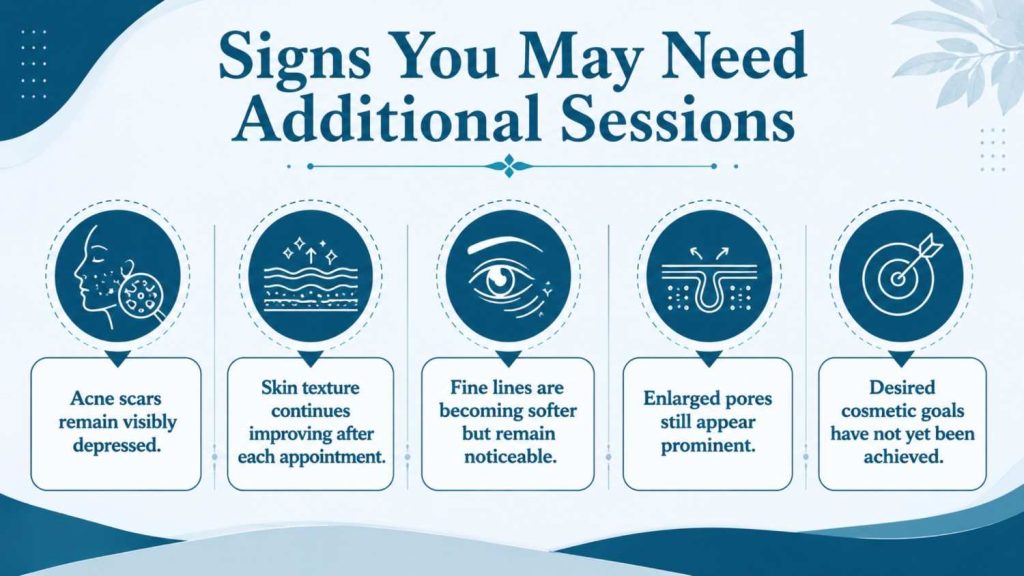
Before recommending further treatment, several aspects of the skin are typically reassessed.
These include:
- Improvement in skin texture
- Scar depth
- Skin firmness
- Overall collagen response
- Healing quality
- Patient satisfaction
Comparing photographs from previous appointments can also help track gradual improvements that may not be obvious from day to day.
How Professionals Monitor Progress
Before recommending further treatment, several aspects of the skin are typically reassessed.
These include:
- Improvement in skin texture
- Scar depth
- Skin firmness
- Overall collagen response
- Healing quality
- Patient satisfaction
Comparing photographs from previous appointments can also help track gradual improvements that may not be obvious from day to day.
When Are Results Usually Noticeable?
Many people begin observing subtle improvements after their initial sessions.
These early changes may include:
- Brighter skin
- Improved smoothness
- Healthier complexion
- Better skin texture
More significant improvements involving acne scars, fine lines, and collagen remodeling generally become increasingly noticeable over subsequent weeks as the skin continues repairing itself.
This gradual progression explains why the answer to how many microneedling sessions are needed depends not only on the number of treatments but also on allowing enough time for the body to complete its natural healing process.
How to Get the Best Results From Every Microneedling Session
Knowing how many microneedling sessions are needed is only one part of achieving healthier-looking skin. The quality of your results also depends on how well you prepare before each treatment and how carefully you care for your skin afterward.
Microneedling stimulates the body’s natural healing process, which means your skin continues repairing itself long after the treatment session ends. Supporting this healing process can help maximize collagen production and improve overall treatment outcomes.
Follow Pre-Treatment Instructions
Preparing your skin properly helps reduce unnecessary irritation before treatment.
General preparation may include:
- Keeping the skin clean
- Avoiding excessive sun exposure
- Avoiding products that may irritate the skin
- Informing your provider about current medications
- Discussing any recent cosmetic procedures
- Reporting active skin infections or inflammation
Healthy skin before treatment often responds better during the healing phase.
Follow Your Aftercare Routine
After every session, your skin needs time to recover.
Following recommended aftercare instructions helps protect the skin while collagen remodeling continues beneath the surface.
Your post-treatment routine may include:
- Using gentle skincare products
- Avoiding harsh exfoliation
- Keeping the skin hydrated
- Protecting the skin from excessive sunlight
- Avoiding unnecessary friction
Proper aftercare supports healthy recovery while minimizing irritation.
Stay Consistent With Your Treatment Plan
One of the biggest reasons people ask how many microneedling sessions are needed is because they expect dramatic improvements after only one treatment.
Microneedling works differently.
Each session builds upon the collagen produced after the previous one.
Remaining consistent with scheduled treatments allows the skin to gradually remodel over time.
Skipping appointments or stopping treatment too early may delay progress.
Be Patient With Collagen Remodeling
Collagen production is a slow biological process.
Although your skin may feel smoother shortly after treatment, deeper improvements continue developing over several weeks.
Patience allows the skin to complete its natural repair cycle.
This gradual improvement often produces natural-looking results rather than sudden changes.
Protect Your Skin Daily
Daily sun protection supports healthier skin throughout your treatment journey.
Excessive ultraviolet exposure may affect the skin’s healing response and contribute to premature collagen breakdown.
Simple protective habits include:
- Limiting prolonged sun exposure
- Wearing protective clothing when appropriate
- Following a consistent skincare routine
- Keeping the skin moisturized
Maintaining healthy skin between appointments helps preserve treatment results.
Common Myths About Microneedling Sessions
Many misconceptions exist regarding how many microneedling sessions are needed. Understanding the facts can help set realistic expectations before beginning treatment.
Myth 1: One Session Is Enough
Although some people notice early improvements after a single treatment, collagen remodeling continues over multiple sessions.
Most skin concerns improve gradually rather than immediately.
Myth 2: More Sessions Mean Faster Results
Treatments should not be performed too frequently.
The skin needs adequate time to heal and produce new collagen before another session.
Following an appropriate treatment schedule is generally more beneficial than increasing treatment frequency.
Myth 3: Everyone Needs the Same Number of Sessions
Every person’s skin is different.
Factors such as age, skin type, scar severity, healing response, and treatment goals all influence how many microneedling sessions are needed.
There is no universal treatment plan that suits everyone.
Myth 4: Results Stop After the Final Session
Collagen remodeling continues even after the last scheduled treatment.
Many individuals continue noticing gradual improvements for several weeks as newly formed collagen matures beneath the skin.
Conclusion
If you’re wondering how many microneedling sessions are needed, the most accurate answer is that it depends on your individual skin condition, treatment goals, and natural healing response. While some people notice early improvements after their first appointment, deeper concerns such as acne scars, uneven texture, and fine lines typically require multiple sessions because collagen remodeling occurs gradually over time.
Rather than focusing only on the number of appointments, it is important to understand that successful microneedling relies on consistency, proper healing intervals, and following recommended aftercare. Every treatment builds upon the collagen produced after the previous session, allowing the skin to become smoother, firmer, and more even with time. For more information about how microneedling works and why multiple sessions may be recommended, refer to the American Academy of Dermatology’s guide to microneedling.