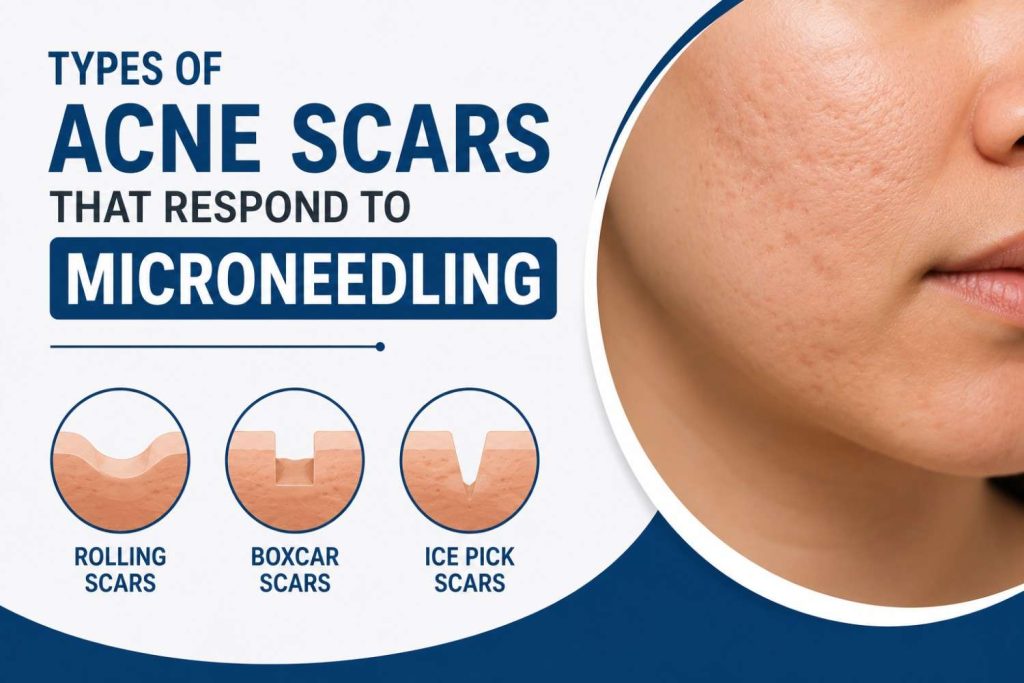
TYPES OF ACNE SCARS THAT RESPOND TO MICRONEEDLING
Acne scars can remain visible even after active acne has cleared, but not every scar has the same structure or responds to treatment in the same way. Understanding the types of acne scars that respond to microneedling can help you know whether this collagen-stimulating procedure may be appropriate for your skin. Microneedling is commonly considered for depressed or atrophic acne scars because it encourages the skin’s natural healing response and supports collagen remodeling.
In Pala, people considering microneedling for acne scars can benefit from a professional skin assessment before treatment. The right approach depends on scar depth, shape, skin condition, and whether active acne is present.
The types of acne scars that respond to microneedling are mainly certain atrophic scars, including rolling and some boxcar scars. Deeper or more complex scars may require another procedure or a combination treatment.
What Are Acne Scars?
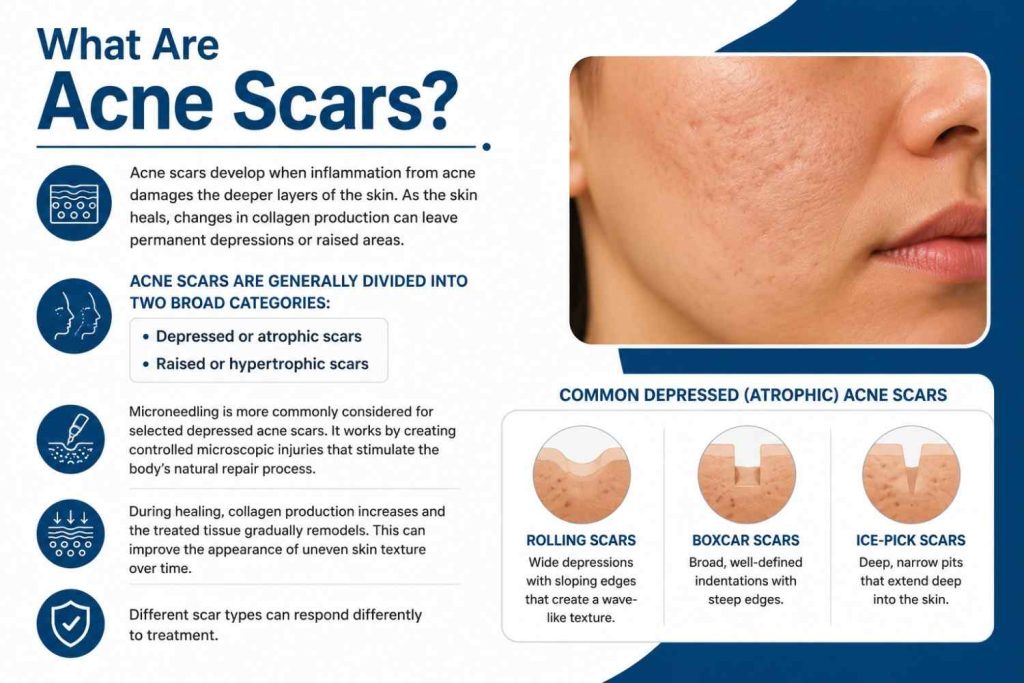
Acne scars develop when inflammation from acne damages the deeper layers of the skin. As the skin heals, changes in collagen production can leave permanent depressions or raised areas.
Acne scars are generally divided into two broad categories:
- Depressed or atrophic scars
- Raised or hypertrophic scars
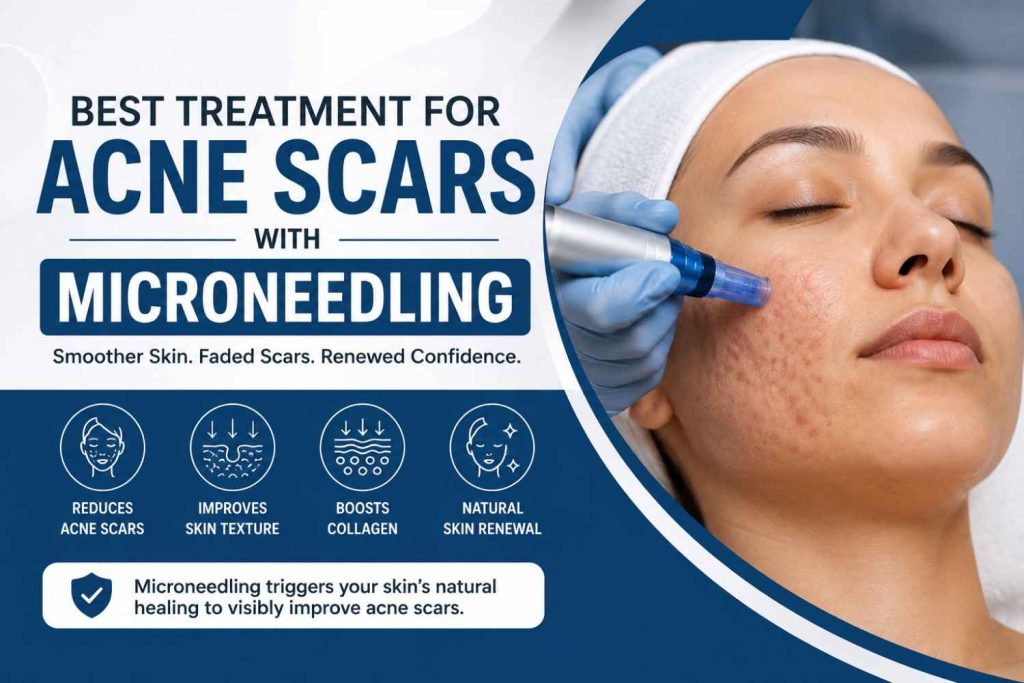
Microneedling is more commonly considered for selected depressed acne scars. It works by creating controlled microscopic injuries that stimulate the body’s natural repair process.
During healing, collagen production increases and the treated tissue gradually remodels. This can improve the appearance of uneven skin texture over time.
The uploaded microneedling content similarly identifies rolling, boxcar, and ice-pick patterns as common atrophic acne scars while emphasizing that different scar types can respond differently to treatment.
Types of Acne Scars That Respond to Microneedling
The types of acne scars that respond to microneedling are primarily atrophic scars. These scars appear as depressions because the skin has lost tissue during the acne-healing process.
1. Rolling Acne Scars
- Rolling scars are among the types of acne scars that respond to microneedling.
- They are usually broad and shallow depressions with soft, rounded edges. Instead of looking like individual holes, rolling scars can create a wavy or uneven appearance across the skin.
- Microneedling may help improve rolling scars by stimulating collagen production and remodeling the tissue beneath the depressed areas.
- As collagen develops, the skin may gradually appear smoother and more even.
Why Rolling Scars May Respond
- Rolling scars are often associated with changes in the underlying collagen structure. Microneedling encourages a controlled healing response that can support collagen remodeling.
- However, some rolling scars are also tethered to deeper tissue. In such cases, microneedling alone may not address the underlying attachment, and another treatment may be considered.
2. Shallow Boxcar Scars
- Shallow boxcar scars are another example among the types of acne scars that respond to microneedling.
- Boxcar scars usually have defined edges and a relatively flat base. They can vary in depth and size.
- Microneedling may be considered for shallow boxcar scars because collagen remodeling can help improve the appearance of the depressed areas.
- The response depends on the depth of the scar. Very deep boxcar scars may not respond sufficiently to microneedling alone.
3. Mild Atrophic Acne Scars
- Mild atrophic scars can sometimes respond well to collagen-induction procedures.
- These scars may appear as subtle depressions or uneven areas that become more visible under certain lighting.
- Microneedling may gradually improve the overall texture by encouraging new collagen formation.
- The treatment does not physically fill the scar immediately. Instead, improvement develops through the body’s natural remodeling process.
Which Acne Scars Respond Best to Microneedling?
Among the different types of acne scars that respond to microneedling, shallower rolling and boxcar scars are generally more suitable candidates than very deep scars.
A professional assessment may consider:
- Scar depth
- Scar shape
- Scar distribution
- Skin thickness
- Skin sensitivity
- Presence of active acne
- Previous scar treatments
- Individual healing response
A treatment plan should be based on these factors rather than simply selecting microneedling because it is a popular procedure.
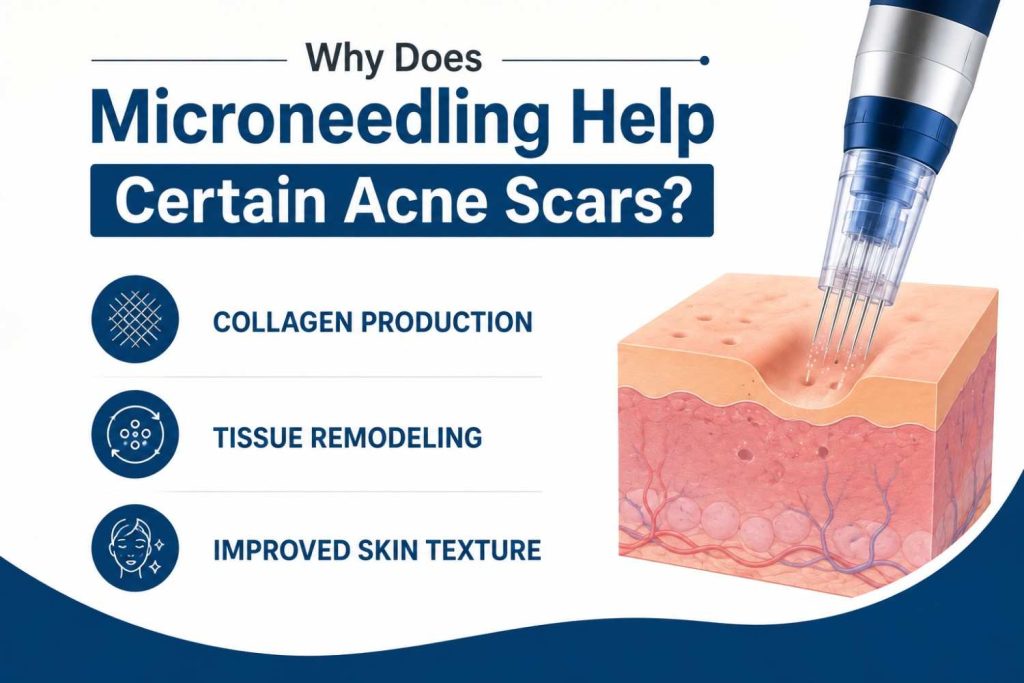
Why Does Microneedling Help Certain Acne Scars?
Microneedling works by creating controlled micro-injuries in the skin.
These tiny channels activate the body’s wound-healing response. During this process, cells involved in tissue repair become active and collagen production increases.
- Collagen Production
Collagen provides structural support to the skin. When collagen production and remodeling increase, depressed areas may gradually become less noticeable.
- Tissue Remodeling
New collagen does not appear instantly. The treated tissue continues to remodel during the weeks and months following treatment.
- Improved Skin Texture
As the skin remodels, irregular areas may become smoother and more even-looking.
This explains why the types of acne scars that respond to microneedling generally require patience and, in many cases, multiple sessions.
Microneedling for Rolling Scars
- Rolling scars often produce an uneven or wavy skin surface.
- Microneedling can stimulate collagen in the treated areas and may improve the overall appearance of these scars.
- However, rolling scars can sometimes have fibrous bands underneath the skin that pull the surface downward.
- When this occurs, microneedling may not be enough by itself. A procedure such as subcision may be considered to release the underlying tethering before or alongside other treatments.
Therefore, identifying the exact structure of a rolling scar is important before deciding on the treatment.
Microneedling for Boxcar Scars
Boxcar scars have sharper borders than rolling scars.
They can be:
- Shallow
- Moderate
- Deep
Shallow boxcar scars may be among the types of acne scars that respond to microneedling, particularly when the main concern is uneven skin texture.
- Deeper boxcar scars may need a more targeted approach.
- A professional assessment can help determine whether microneedling is appropriate or whether another treatment would provide a more suitable approach.
Raised Acne Scars and Microneedling
- Raised acne scars are different from the depressed types of acne scars that respond to microneedling.
- Hypertrophic scars develop when excess collagen creates a raised area.
- Microneedling is not generally considered the first choice for treating raised acne scars because its collagen-stimulating mechanism may not address the underlying problem appropriately.
- People with raised scars should receive a professional assessment before considering microneedling.
How Many Microneedling Sessions Are Needed?
There is no fixed number of sessions for all types of acne scars that respond to microneedling.
Treatment requirements depend on:
- Scar severity
- Scar type
- Skin response
- Treatment depth
- Previous procedures
- Desired improvement
- Healing capacity
Acne-scar treatment commonly involves a series of sessions rather than one appointment.
Sessions are generally spaced apart to allow the skin to heal and collagen to remodel.
When Will Microneedling Results Appear?
One important point about the types of acne scars that respond to microneedling is that improvement is gradual.
Immediately after treatment, temporary redness and sensitivity may occur.
Once the skin settles, the collagen-remodeling process continues underneath the surface.
Over time, you may notice:
- Improved skin texture
- Softer-looking scar edges
- Reduced visibility of shallow depressions
- Smoother skin
- More even-looking skin
The results continue to develop as the skin produces and remodels collagen.
Who May Be a Good Candidate?
People with certain depressed acne scars may be candidates for microneedling.
A professional may consider microneedling when a person has:
- Rolling scars
- Shallow boxcar scars
- Mild atrophic scars
- Uneven skin texture
- Stable acne
- Realistic treatment expectations
However, active acne, skin infections, open wounds, significant irritation, or certain medical conditions may require treatment to be delayed.
Who May Not Be Suitable for Microneedling?
Not everyone with acne scars is automatically suitable.
Microneedling may need to be postponed or avoided in people with:
- Active skin infections
- Deep inflammatory acne
- Open wounds
- Significant skin irritation
- Certain healing disorders
- A history of problematic scarring
- Certain medications affecting wound healing
- Recent procedures affecting the skin
A qualified professional should review your skin condition before treatment.
Tips for Choosing the Right Acne Scar Treatment
Choosing among the types of acne scars that respond to microneedling starts with an accurate assessment.
Consider these factors:
- Identify the exact scar type.
- Determine whether the scars are depressed or raised.
- Check whether active acne is still present.
- Discuss previous scar treatments.
- Ask whether microneedling alone is appropriate.
- Understand the expected number of sessions.
- Follow recommended aftercare.
- Maintain realistic expectations.
The most appropriate treatment is the one that matches the structure and severity of the scars.
Conclusion
Understanding the types of acne scars that respond to microneedling is an important step before choosing a scar treatment. Microneedling is primarily considered for selected depressed acne scars, particularly rolling scars and some shallow boxcar scars. By creating controlled micro-injuries, it stimulates the skin’s natural repair response and supports collagen remodeling.
Ice pick scars, deep boxcar scars, raised scars, and tethered rolling scars may require different or combination approaches. This is why professional assessment is essential before treatment. The goal is not simply to choose a procedure but to match the treatment to the structure of the scar.
With appropriate treatment planning, realistic expectations, proper session spacing, and careful aftercare, microneedling may help create smoother-looking and more even skin. If you are considering the types of acne scars that respond to microneedling in Pala, a professional skin assessment can help determine whether microneedling is appropriate for your individual scars.According to the American Academy of Dermatology (AAD), microneedling can stimulate collagen production and help improve the appearance of acne scars, fine lines, wrinkles, and uneven skin texture.