Causes of Hair Fall: 12 Powerful Reasons You Should Know Now
Causes of hair fall can vary from temporary shedding to conditions that cause progressive hair thinning. Noticing more hair than usual on your pillow, comb, or shower floor can naturally make you wonder what is happening. While some daily shedding is part of the normal hair cycle, excessive shedding, visible thinning, or bald patches may need closer attention.
Hair loss can happen for many different reasons. Genetics, stress, hormonal changes, nutritional deficiencies, illness, scalp conditions, medications, tight hairstyles, and excessive chemical or heat exposure can all contribute to increased shedding or thinning. In some cases, more than one factor may be involved.
At Vita Clinic, Dr. Sherin Dominic (MBBS, MD, DNB), Consultant Dermatologist and Aesthetic Medicine Specialist, evaluates skin, scalp, and hair concerns based on individual clinical needs. Understanding the underlying reason for hair loss is an important first step before deciding on an appropriate treatment approach
What Are the Causes of Hair Fall?
The causes of hair fall are not the same for everyone. Hair may fall because of a temporary change in the hair growth cycle, an ongoing condition affecting the follicles, an internal health issue, or repeated damage to the hair and scalp.
Some common causes include:
- Hereditary hair loss
- Stress and emotional strain
- Telogen effluvium
- Hair shedding after childbirth
- Iron and other nutritional deficiencies
- Thyroid disorders
- Hormonal changes
- Polycystic ovary syndrome
- Certain medications
- Scalp infections and inflammatory conditions
- Tight hairstyles and traction
- Chemical and heat damage
- Rapid weight loss
- Restrictive diets
- Some autoimmune conditions
How Does the Hair Growth Cycle Work?
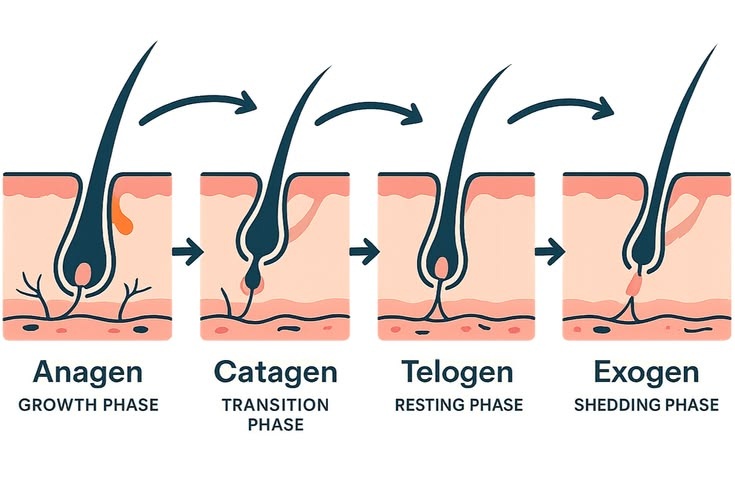
To understand the causes of hair fall, it helps to know that every hair follicle naturally moves through different stages of growth, transition, rest, and shedding.
Anagen Phase – Growth Phase
This is the active growth phase. The hair follicle continuously produces a hair shaft during this stage. Most scalp hairs remain in the anagen phase for several years.
Catagen Phase – Transition Phase
This is a short transition phase in which active hair growth gradually slows down. The hair follicle becomes smaller and prepares to enter the resting stage.
Telogen Phase – Resting Phase
During the telogen phase, the hair follicle remains inactive for a period of time. The old hair stays attached to the follicle while the next growth cycle is prepared.
Exogen Phase – Shedding Phase
The exogen phase is the shedding stage of the hair cycle. During this phase, an old hair is released from the follicle and eventually falls out. A new hair can then begin growing as the follicle returns to the anagen phase.
When a larger number of follicles enter the resting or shedding stages around the same time, noticeable hair fall can occur. This may happen following significant stress, illness, fever, surgery, childbirth, major dietary changes, or rapid weight loss.
12 Powerful Causes of Hair Fall and When to See Your Doctor
1. Hereditary Hair Loss
One of the most common causes of hair fall is genetic or hereditary hair loss.
It can affect both men and women, although the pattern may differ.
Men may notice:
- Receding hairline
- Thinning at the crown
- Gradual reduction in hair density
- A developing bald area
Women may notice:
- A widening central part
- Diffuse thinning
- Reduced ponytail thickness
- Increased visibility of the scalp
Hereditary hair loss usually develops gradually. Hair follicles can become progressively smaller, resulting in thinner and shorter hair over time.
Early evaluation may help determine whether the pattern is consistent with hereditary hair loss and what management options may be suitable.
2. Stress and Telogen Effluvium
Stress is another important factor among the causes of hair fall.
Major physical or emotional stress can temporarily affect the hair growth cycle. Increased shedding can occur after:
- Significant emotional stress
- High fever
- A major illness
- Surgery
- Rapid weight loss
- Major dietary changes
- Childbirth
An important feature of stress-related hair shedding is that it may not happen immediately. Some people notice increased shedding weeks or months after the triggering event.
When the underlying trigger settles, some temporary forms of shedding may gradually improve. However, persistent hair fall should still be assessed because stress may not be the only contributing factor.
3. Postpartum Hair Shedding
Hair shedding after pregnancy is another common concern.
During pregnancy, hormonal changes can alter the normal hair cycle. After childbirth, hormonal levels change again, and a larger number of hairs may enter the resting and shedding stages.
Women may notice:
- More hair on the pillow
- Increased shedding during washing
- Hair coming out during brushing
- A thinner-looking ponytail
Postpartum shedding is often temporary, but the degree and duration can vary.
When hair fall is unusually heavy, continues for a long time, or is accompanied by other symptoms, a dermatological evaluation can help determine whether another factor is contributing.
4. Iron Deficiency and Other Nutritional Problems
Nutrition can influence hair growth.
Hair follicles need adequate nutrients to support normal growth, and insufficient intake or absorption of certain nutrients may contribute to hair thinning or increased shedding.
Possible nutritional factors include:
- Iron deficiency
- Low protein intake
- Zinc deficiency
- Certain vitamin deficiencies
- Very low-calorie diets
People who follow restrictive diets or experience rapid weight loss may be more likely to develop nutritional gaps.
However, taking supplements without knowing whether a deficiency exists is not always appropriate. A clinical assessment can help determine whether nutritional testing may be useful.
The goal is not simply to take more supplements, but to identify whether a genuine deficiency or dietary issue is contributing to the hair loss.
5. Thyroid Disorders
Thyroid disorders can also be among the causes of hair fall.
Both an underactive thyroid and an overactive thyroid may affect the hair growth cycle.
Hair changes may occur alongside other symptoms such as:
- Unexplained changes in weight
- Fatigue
- Changes in energy
- Temperature sensitivity
- Menstrual changes
- Skin changes
Hair loss does not automatically mean that there is a thyroid problem. However, when shedding occurs together with other unexplained symptoms, further evaluation may be appropriate.
6. Hormonal Changes and PCOS
Hormones can have a significant influence on hair growth.
Hair thinning may occur with:
- Polycystic ovary syndrome
- Menopause
- Pregnancy-related hormonal changes
- Postpartum hormonal changes
- Changes in hormonal medication
- Other hormonal imbalances
Women with hormonal hair concerns may sometimes notice other changes such as acne, irregular periods, increased facial hair, or changes in body weight.
These symptoms can have multiple possible explanations. A proper assessment is important before assuming that a hormonal disorder is the cause.
7. Medications and Medical Treatments
Certain medications and medical treatments can contribute to increased hair shedding.
The effect depends on the medication, dose, duration, and individual response.
If you think a prescribed medicine may be affecting your hair, it is important not to stop the medication on your own. Instead, discuss the concern with the doctor who prescribed it.
A doctor can review the timing of the hair loss, the medications involved, and other possible contributing factors before deciding what should be done.
8. Scalp Conditions and Inflammation
A healthy scalp is an important part of healthy hair growth.
Scalp disorders can contribute to:
- Excessive shedding
- Hair breakage
- Localized hair loss
- Scalp irritation
- Inflammation
Some common symptoms include:
- Itching
- Redness
- Scaling
- Flaking
- Burning
- Tenderness
- Persistent scalp discomfort
Conditions such as dandruff, seborrheic dermatitis, psoriasis, fungal infections, and other inflammatory scalp problems may require appropriate medical treatment.
Persistent scalp symptoms combined with hair loss should not simply be treated as a cosmetic issue.
9. Tight Hairstyles and Traction Alopecia
Repeated tension on the hair can be another cause of hair loss.
Tight hairstyles may include:
- Very tight ponytails
- Tight buns
- Certain braids
- Hair extensions
- Repeated pulling or tying
Long-term tension may lead to a condition known as traction alopecia.
Hair loss may initially appear around the hairline or other areas under repeated tension. If the pulling continues for a prolonged period, follicle damage can become more significant.
A simple practical clue is discomfort. If your hairstyle causes scalp pain, pulling, or tenderness, it may be placing too much tension on the hair.
10. Chemical and Heat Damage
Hair can also become weaker because of repeated external damage.
Frequent:
- Bleaching
- Colouring
- Straightening
- Perming
- Heat styling
- Chemical relaxing
can weaken the hair shaft and make it more prone to breakage.
This is different from hair loss caused by a problem inside the follicle. With breakage, the hair may snap along its length, making the hair look thinner even when the follicles themselves are not the primary problem.
Gentler hair-care habits can help reduce avoidable damage.
11. Rapid Weight Loss and Restrictive Diets
Rapid weight loss can place physical stress on the body.
Very restrictive diets may also make it difficult to obtain enough protein, iron, zinc, and other nutrients needed for overall health.
Hair shedding may therefore increase after periods of:
- Crash dieting
- Very low-calorie eating
- Rapid weight reduction
- Prolonged restrictive diets
A balanced approach to nutrition is generally more suitable than extreme dietary restrictions.
When hair loss develops after major dietary changes, it may be helpful to review both the timing of the shedding and the overall nutritional pattern.
12. Autoimmune and Other Medical Conditions
Some forms of hair loss are associated with immune-system activity affecting the hair follicles.
One example is alopecia areata, which may cause clearly defined patches of hair loss.
People may notice:
- Round or irregular bald patches
- Sudden localized hair loss
- Eyebrow thinning
- Eyelash loss
- Hair loss in other body areas
Is Hair Fall Normal or a Problem?
Some daily shedding is normal because hair is constantly moving through its natural growth cycle.
The amount of hair lost each day can vary between individuals, so focusing only on counting individual strands is not always useful.
Instead, pay attention to changes in your normal pattern.
Hair Fall May Be Temporary When:
- It follows a recent illness
- It starts after significant stress
- It occurs after childbirth
- It follows major weight loss
- There are no clearly defined bald patches
- Overall density remains relatively stable
Hair Loss May Need Professional Evaluation When:
- Shedding suddenly becomes much heavier
- Hair is becoming progressively thinner
- Your part is becoming wider
- Your hairline is receding
- Bald patches appear
- The scalp is becoming more visible
- Eyebrows or eyelashes are also affected
- There is persistent scalp itching or redness
- The scalp is painful or tender
- Hair loss continues for an extended period
Different Patterns of Hair Loss
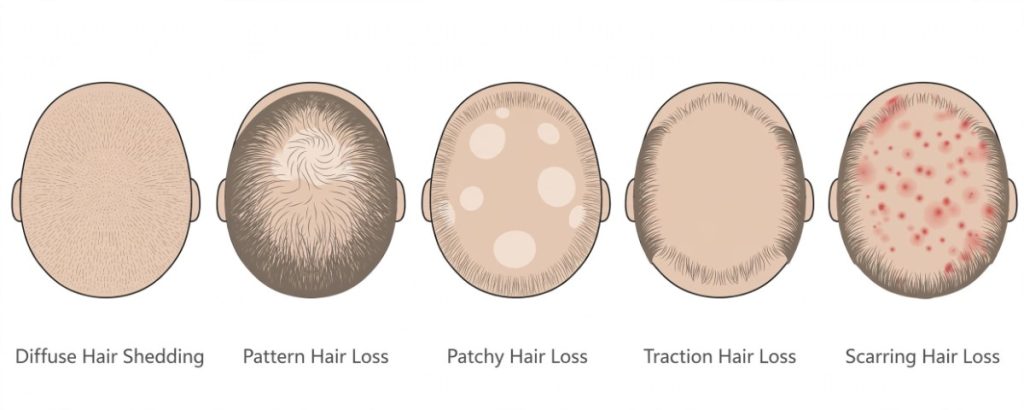
Understanding the pattern can provide useful information about possible causes of hair fall.
Diffuse Hair Shedding
Hair becomes less dense across a large part of the scalp.
This may occur after stress, illness, nutritional problems, hormonal changes, or other temporary triggers.
Pattern Hair Loss
Hair gradually becomes thinner in a recognizable pattern.
This is commonly associated with hereditary factors.
Patchy Hair Loss
Hair disappears from specific areas of the scalp.
Autoimmune or infectious conditions can sometimes cause this pattern.
Traction Hair Loss
Repeated tension causes thinning in areas exposed to pulling.
Scarring Hair Loss
Inflammation damages the follicle and may prevent future hair growth from the affected area.
Identifying the pattern is an important part of understanding what may be happening.
How Are the Causes of Hair Fall Evaluated?
A proper evaluation starts with understanding your individual history.
A dermatologist may ask about:
- When the hair loss started
- Whether it was sudden or gradual
- Family history
- Recent illness or fever
- Stress
- Pregnancy or childbirth
- Weight changes
- Diet
- Medications
- Supplements
- Hormonal changes
- Scalp symptoms
- Hair-care practices
The scalp and hair can then be examined to understand the pattern and distribution of the loss.
Depending on the clinical findings, additional investigations may sometimes be recommended.
These may include tests related to:
- Iron status
- Thyroid function
- Vitamin levels
- Hormonal factors
- Other medical causes
Treatment for Hair Fall Depends on the Cause
There is no single treatment that works for every type of hair loss.
The appropriate management depends on why the hair is falling.
Nutritional Causes
When a genuine nutritional deficiency is identified, correcting the deficiency may form part of the treatment plan.
Scalp Conditions
Scalp infections, inflammation, dandruff-related problems, or other scalp disorders may require condition-specific treatment.
Hereditary Hair Loss
Certain medical treatments may be appropriate for selected patients depending on the pattern, stage, health status, and individual needs.
Hormonal or Medical Causes
If an underlying medical or hormonal issue is contributing to the hair loss, addressing that problem may be an important part of overall management.
Hair Restoration Options
Some individuals with particular types of hair thinning may be suitable for procedures such as PRP or hair transplantation.
These options are not appropriate for everyone. Suitability depends on the diagnosis, follicle health, available donor hair, overall health, and individual goals.
At Vita Clinic, hair and scalp concerns can be evaluated to help determine an appropriate management approach based on the individual’s clinical needs.
Benefits of Identifying the Cause of Hair Fall
Understanding the underlying reason for hair loss can make the next steps clearer.
1. Less Guesswork
You do not have to keep changing shampoos, oils, supplements, or home remedies without knowing what you are treating.
2. More Appropriate Treatment
Different types of hair loss require different approaches.
3. Recognition of Underlying Problems
Hair loss can sometimes be associated with nutritional, hormonal, thyroid, scalp, or other medical issues.
4. Better Management of Progressive Hair Loss
Some conditions may benefit from assessment before substantial thinning occurs.
5. More Realistic Expectations
Knowing the diagnosis can help you understand whether improvement may occur naturally or whether ongoing treatment may be needed.
Simple Hair-Care Tips
Not every case of hair loss can be prevented, but certain habits can help reduce avoidable damage.
- Avoid consistently tight hairstyles.
- Reduce unnecessary heat styling.
- Handle wet hair gently.
- Avoid aggressive brushing.
- Limit repeated bleaching and chemical processing.
- Maintain a balanced diet.
- Include sufficient protein in your meals.
- Avoid crash diets.
- Treat persistent scalp symptoms.
- Avoid taking high-dose supplements without proper guidance.
- Follow prescribed treatment as advised.
- Pay attention to sudden changes in hair density.
Healthy hair care should focus on both the scalp and the hair shaft.
When Should You See a Dermatologist?
It is worth considering a dermatology consultation when hair fall is sudden, persistent, progressive, or associated with other symptoms.
Seek professional attention when you notice:
- Sudden heavy shedding
- Rapid thinning
- A widening hair part
- Receding hairline
- Bald patches
- Eyebrow or eyelash loss
- Persistent scalp itching
- Redness or scaling
- Scalp pain or tenderness
- Hair loss after a major illness
- Hair loss with hormonal or nutritional symptoms
- Hair fall that does not settle over time
A dermatologist can help distinguish excessive shedding from other types of hair loss and determine whether further evaluation is appropriate.
Hair and Scalp Care at Vita Clinic
At Vita Clinic, hair and scalp concerns are approached with attention to the individual’s clinical history, symptoms, and hair-loss pattern.
The clinic is led by Dr. Sherin Dominic (MBBS, MD, DNB), Consultant Dermatologist and Aesthetic Medicine Specialist. Her approach combines clinical precision with refined aesthetic understanding.
When hair fall becomes persistent or difficult to explain, identifying the underlying reason is an important part of deciding what type of management may be appropriate.
Rather than assuming that every case is caused by stress, vitamin deficiency, or genetics, a personalized dermatological assessment can help provide a clearer picture of what may be contributing to the problem.
Frequently Asked Questions
1. What are the main causes of hair fall?
The main causes of hair fall can include hereditary factors, stress, telogen effluvium, hormonal changes, nutritional deficiencies, thyroid disorders, scalp conditions, medications, tight hairstyles, chemical damage, rapid weight loss, and some medical conditions.
2. Is some daily hair fall normal?
Yes. Some amount of daily shedding is part of the normal hair cycle. What matters is whether there has been a clear increase from your usual shedding pattern or visible thinning.
3. Can stress cause hair fall?
Yes. Significant physical or emotional stress can temporarily disturb the hair growth cycle and may lead to increased shedding.
4. Can poor nutrition cause hair loss?
Yes. Inadequate intake of certain nutrients may contribute to hair thinning or increased shedding. Extremely restrictive diets can also affect overall hair health.
5. Can iron deficiency cause hair fall?
Iron deficiency may contribute to hair loss in some people. Whether testing is needed depends on the person’s symptoms, medical history, and clinical assessment.
6. Can thyroid problems cause hair fall?
Yes. Thyroid disorders may affect the hair growth cycle and can contribute to increased shedding or thinning.
7. Why does hair fall after pregnancy?
Hormonal changes following childbirth can cause a larger number of hairs to enter the shedding phase. This can make postpartum hair fall appear more noticeable for a period of time.
8. Can PCOS cause hair loss?
Hormonal changes associated with PCOS can contribute to certain patterns of scalp hair thinning. Other symptoms may also be present, so evaluation is useful when hormonal hair loss is suspected.
9. Can tight hairstyles cause permanent hair loss?
Repeated tension can cause traction alopecia. If the pulling continues for a long time and significant follicle damage occurs, some hair loss may become permanent.
10. Can dandruff cause hair fall?
Scalp conditions involving inflammation, itching, scaling, or infection can contribute to increased shedding or hair loss. Persistent scalp problems should be evaluated appropriately.